- Weekly.health
- Posts
- Issue 23: Nutrition made simple - 50% off this week
Issue 23: Nutrition made simple - 50% off this week
The latest nutrition research and actionable tips to improve your health, 50% off our course, and a deep dive on magnesium supplements.

James K
November 28, 2025
In partnership with

Welcome to Weekly.health’s 23rd issue. Every week, we explore cutting-edge research, actionable advice, and science-backed nutrition insights to help you live longer and healthier.
Our aim is to help you live another 10 healthy years and cut your risk of age-related disease.
🗒️ In This Issue:
🆕 Foundations of Nutrition Is Now Live: 50% Off This Week
📚 Books We’re Reading Right Now
🕒 Longevity Digest: Recent research on ageing
📈 Research Digest: What’s new in nutrition science
💊 Supplement Deep Dive: Magnesium
🛍️ Purchases We Recommend
❤️ Support Weekly.health: Help us keep the research flowing
📘 Glossary of Terms: Definitions for technical terms in this issue
🆕 Foundations of Nutrition Is Now Live - 50% Off This Week
Our first course, Foundations of Nutrition, is now available, and for this week only it’s 50% off with the code BLACKFRIDAY.
If you're looking for a clear, science-based way to understand nutrition properly - without rules, confusion, or overwhelm - and in just 10 minutes a day… this course is for you.
📚 Books We’re Reading Right Now
 | If you read just one book to future-proof your health, make it How Not to Age by Dr Michael Greger. Dr Greger - the physician behind How Not to Die and NutritionFacts.org - is known for one thing: turning hard science into practical, life-extending habits. Every claim he makes is rooted in peer-reviewed research, not hype. In How Not to Age, he reveals what truly slows biological ageing, from protecting your brain and heart to preserving muscle and energy. It’s a science-backed guide to living not just longer, but better. Weekly.health may be compensated when you buy. Your purchase helps to support us to continue this newsletter. |
🕒 Longevity Digest: Recent Research on Ageing
🌱 Ageing well is surprisingly lifestyle-driven
This review of 35 trials (25,000 adults aged 50+) shows that small, everyday habits genuinely slow age-related decline. A Mediterranean-style diet cut cardiovascular risk by 22%, aerobic exercise improved fitness (VO₂ max +3.6 mL/kg/min), and mindfulness reduced stress by 35%. Seven to eight hours of sleep lowered cognitive decline risk by 25%. Combine these habits for the biggest impact. (source)
Here’s a bit more about each intervention this study looked at;
🥗 Mediterranean-style eating boosts heart & brain health
Eating mostly plants, olive oil, fish, nuts, and whole grains cuts cardiovascular risk by ~22% and reduces cognitive decline. Make most meals “Mediterranean” and aim for 1–1.2 g protein/kg daily to maintain muscle.
🏋️ Aerobic + resistance training keeps you strong and mobile
Just 150 minutes of brisk walking weekly plus 2 resistance sessions improves fitness (VO₂ max +3.6 mL/kg/min) and cuts frailty risk by a third. Think: walk daily, lift twice a week.
🧠 Mindfulness and cognitive training protect memory
Mindfulness, puzzles, learning new skills, or structured cognitive stimulation reduce dementia risk by ~25% and lowers stress. Ten minutes of daily mindfulness + one mentally challenging hobby is a powerful combo.
🤝 Staying socially connected reduces depression by 30%
Regular contact with friends, community activities, or group hobbies boost life satisfaction by 45%, and protects against low mood. Schedule 2+ social touchpoints weekly.
🚭 Ditching smoking slashes heart risk
Stopping smoking reduces cardiovascular complications by 32% and improves long-term survival. Even quitting after 50 provides big benefits.
🍷 Keep alcohol moderate
Up to 1 drink/day (women) or 1–2 (men) is linked with better liver markers than abstaining or heavy drinking. Over this, risks rise quickly.
😴 Sleep 7–8 hours to protect your brain
Consistent sleep of 7–8 hours reduces cognitive decline by ~25%. CBT-I is highly effective if you struggle with insomnia.
🩺 Preventive healthcare catches problems early
Routine check-ups reduce undiagnosed chronic disease by 40%, and vaccinations cut flu-related hospitalisations. Get annual bloods and stay up to date with immunisations.
📈 Research Digest: What’s New in Nutrition Science
Here’s the best of recent nutrition research:
🍇 Mediterranean diet helps brains without the daily wine
In 75 Portuguese adults aged 55–85 at high dementia risk, a Mediterranean diet score only predicted better cognitive test results when low wine intake scored higher. When wine was counted as “healthy”, the link disappeared. Takeaway: enjoy a Mediterranean-style diet rich in plants and olive oil, but don’t rely on a daily glass of wine for brain health. (source)
🍽️ Eat like it’s sunny, even when the air isn’t clear
In 17,254 UK adults exposed to common air pollutants, shifting towards healthier patterns - Mediterranean-style, plant-rich, diverse, antioxidant and anti-inflammatory diets - was estimated to prevent up to ~10 diabetes cases, ~16 kidney disease cases, ~12 dementia cases and ~10 deaths per 1,000 people over 13 years. Build plates around veg, fruit, whole grains, beans, nuts and olive oil, while cutting ultra-processed foods and red meat. (course)
🧠 Daily lifestyle coaching helped older adults with memory issues maintain their cognitive health.
Over 52 weeks, participants with mild cognitive impairment logged every meal with nutrition feedback three times a week, set personal weekly activity goals with tailored coaching, and received monthly checks on blood pressure, weight and blood sugar, plus extra guidance when readings were off. This steady support kept their cognition stable while the control group declined. Takeaway: build a simple routine, track your meals, move daily, and monitor key health numbers, to meaningfully protect long-term brain health. (source)
🌱 Foundations of Nutrition - Now Live (50% Off This Week)
If you’ve ever felt like nutrition is confusing or contradictory, you’re not alone.
This course was built to give you complete clarity, without overwhelm - a calm, practical, science-based foundation you can actually use in daily life.
What you’ll learn in just 10 minutes a day
How energy balance and metabolism really work
How to build satisfying, balanced meals without tracking or rules
What protein, fibre, carbs, fats, and micronutrients actually do
How to turn knowledge into habits through worksheets and a 6-week plan
What you get when you join
Short, focused lessons designed for a busy life
21 actionable lessons over 5 modules
The essentials of nutrition and how to implement it into your life
Practical worksheets + habit tools
A complete step-by-step framework
Lifetime access
Here’s a sneak peak at lesson 1

Launch offer - 50% off this week only
Use code: BLACKFRIDAY
£59 → £29.50 (UK)
$75 → $37.50 (US & elsewhere)
🟢 Sponsors: AG1 & Medik8
The daily health habit you’ll actually stick with…

This time of year, it’s SO hard to stay in control of your health.
Holiday travel (and meals!), big family gatherings, dark and cold days, it’s easy to skip that workout, sleep in later than you should, or have just one more cookie.
That’s why you need a daily health habit that’s easy to stick with.
Meet AG1: With just one quick scoop every morning, you’ll get over 75 ingredients that help support your immune health, gut health, energy, and close nutrient gaps in your diet.
Right now is the best time to get started - with every new subscription, they are giving away $126 in free gifts for the holidays.
Give AG1 a try today and take control of your health this holiday season.
30% off Medik8 Starts NOW

Black Friday is here, but these deals won’t last long! Shop Medik8 and save 30% off your must-have products*
*Terms & Conditions Apply
💊 Supplement Deep Dive: Magnesium
Should you be taking taking magnesium supplements?

1-minute verdict
Try (targeted): Small but valuable benefits to those with low consumption of nuts, seeds, wholegrains, and legumes, and who experience poor sleep or low mood.
Outcomes that matter;
Reduced time to fall asleep in older adults with insomnia (avg 17 minutes)
Reduced depression scores in small trials moderately
Small improvements in anxiety and stress scores in some trials
Time to benefit: 2–12 weeks for sleep and mood
Who might skip or adjust: Those with moderate-severe kidney disease. Those already using magnesium-containing laxatives/antacids.
Upper limit: 350 mg/day elemental magnesium from supplements (check labels). Food sources generally unrestricted.
Does it actually do anything?
Sleep
A 2025 evidence review pooling three RCTs in adults with insomnia symptoms found that magnesium supplementation reduced sleep onset latency by ~17 minutes vs placebo – a modest but clinically relevant effect. (source)
In a 2024 RCT, 1 g/day magnesium L-threonate in adults with self-reported sleep problems improved subjective sleep quality, deep/REM sleep, mood, energy and daytime functioning vs placebo. (source)
Anxiety, stress & mood
A 2017 systematic review (18 RCTs) found magnesium may reduce subjective anxiety and stress, especially in people with mild–moderate anxiety and low baseline magnesium, but study quality was variable. (source)
A 2023 meta-analysis reported a significant reduction in depression scores with magnesium supplementation versus control, though heterogeneity and small sample sizes mean this is still “promising” rather than definitive. (source)
Cognition (L-threonate)
RCTs in older adults and middle-aged adults with poor sleep and subjective memory complaints show improvements in composite cognitive scores and working memory with 1.5–2 g/day Mg L-threonate over 12 weeks vs placebo. (source)
Our take: effects are small to moderate, not dramatic. Magnesium is best thought of as a foundational co-factor, especially helpful if your intake is low or stress load is high, less noticeable if you’re already consuming adequate amounts through diet.
Who is most likely to benefit?
People who might get the most out of magnesium are those who:
Have a low intake of nuts, seeds, wholegrains, pulses and greens.
Have a high stress load, frequent muscle tension, migraines or cramps (as part of a broader plan).
Are perimenopausal or post-menopausal women with sleep disruption and anxiety.
Are endurance or high-volume athletes with heavy sweat losses.
Dose & form
Effective dose range:
Typical recommended intakes from diet: 310–320 mg/day (women) and 400–420 mg/day (men) in the US; similar reference values in Europe.
Upper limit for supplements/medicines in adults is usually set around 350 mg/day elemental magnesium (food doesn’t count towards this).
Forms:
Magnesium glycinate (bisglycinate) – sleep & calm
Magnesium malate – energy & muscles
Magnesium L-threonate (MgT) – brain & sleep depth
Our picks - what to buy
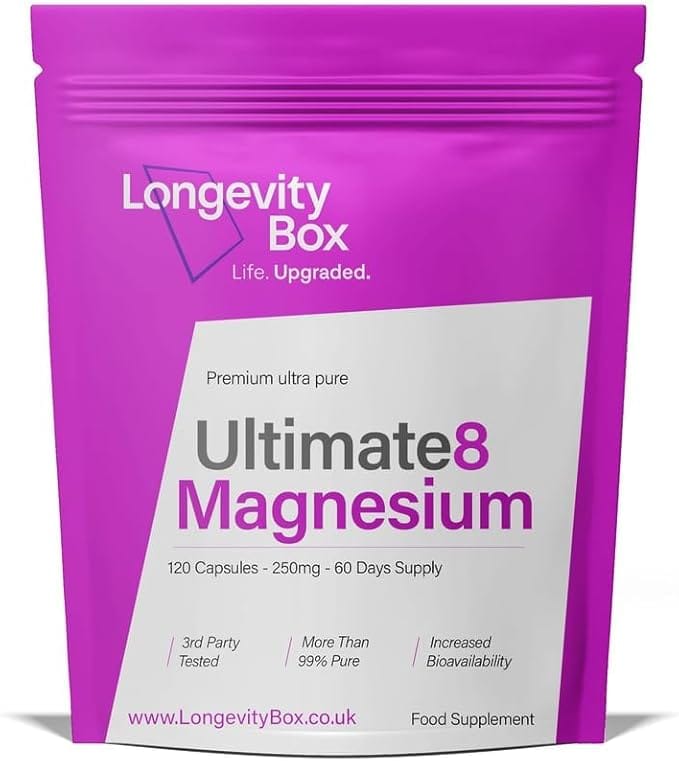 Longevity Box Ultimate8 Magnesium |  Vivonu Magnesium Complex |
Stack sensibly (optional)
Evening: magnesium glycinate ± extra glycine or a low-dose theanine as a gentle wind-down stack.
Daytime energy/muscle: magnesium malate with electrolytes (sodium/potassium), especially in endurance athletes or heavy sweaters.
Brain stack: Mg L-threonate alongside omega-3 (EPA/DHA) and choline-rich foods for general brain support (evidence is stronger for omega-3 than for any single “nootropic” supplement).
Mechanism minute (for the curious)
Nervous system: magnesium sits in the NMDA receptor channel and helps prevent excessive glutamate signalling; it also supports GABAergic tone which underpins its calming and neuroprotective effects.
Energy: it’s required for ATP to function (technically “Mg-ATP”), so low magnesium can show up as fatigue, muscle weakness and poor exercise tolerance.
Stress axis: magnesium helps regulate the HPA axis and cortisol response, which may explain some benefits in stress and mild anxiety.
Brain-specific (L-threonate): MgT appears to increase brain magnesium more than other forms in animal and early human work, supporting synaptic density and plasticity, basically making neurons more resilient and efficient.
Safety & cautions
Main issue at higher doses = loose stools, cramping, nausea, especially with citrate/oxide; glycinate, malate and threonate are generally gentler.
Next-day grogginess if dose is too high or taken very late at night (some people do better taking it 1–2 hours before bed, not right at lights-out).
Some should not self-supplement heavily;
Significant kidney disease (reduced ability to clear magnesium).
On high-dose magnesium medicines already (e.g. some laxatives).
Children and teens – only under professional guidance.
🔧 Update: The Healthspan Academy
Last week we launched The Healthspan Academy, with a full suite of tools to help you optimise your health.
Our last issue was so popular, our email open-rate was 20% higher than normal, and our click-rate was more than double what we normally get.
Weekly.health readers calculated their BMI, TDEE, BMR, and other health metrics more than 500 times, and more than 200 recipes were generated using our AI Meal Plan Generator, for free.
We’re thrilled our platform got off to such a great start, but there’s still more to come, and The Healthspan Academy will make a regular appearance in these issues as a supporting platform to give you practical ways to use what you learn in Weekly.health.
🛍️ Purchases we recommend
Discover the products, services, and retailers we’ve mentioned in past Weekly Health issues, all in one place so you can explore at your own pace.
🇬🇧 UK Readers Osavi Omega-3 Oil – Contains 2,450mg EPA and DHA per teaspoon Merach Exercise Bike – The exact exercise bike we use at Weekly.health Piper’s Farm – Award-winning 100% grass-fed meats for better flavour and nutrition. Get £10 off your first order. Abel & Cole – Fresh, organic fruit and veg boxes to make healthy eating easier. 50% off your first four boxes. Oddbox – Help fight food waste with weekly deliveries of delicious “wonky” veg. £10 off your first box. Crowdfarming – Adopt a fruit tree and enjoy regular deliveries. Get 10€ credit when you join. Citizens Of Soil – Use code WKLYOLIVE10 for 10% off small-batch, high-antioxidant extra virgin olive oils. The Mediterranean Diet Cookbook For Beginners – 100 irresistible recipes, a 14-day meal plan, and practical tips for shopping, cooking, and living the Mediterranean way. The Official MIND Diet Book: – A scientifically based programme to support weight loss and brain health. Longvida Curcumin Supplement – One of the best-supported curcumin formulas in human studies. Use code weeklyhealth for 15% off £30+. Dash Diet Cookbook For Busy People – Nutritious, 5-ingredient recipes that make healthy eating stress-free. Keto Diet Cookbook – Your 30-day plan to lose weight, boost brain health, and balance hormones. Lifespan by Dr. David Sinclair – One of the world's leading researchers on ageing lays out the science behind why we age and what we can do to slow it down. | 🇺🇸 USA Readers Carlson Finest Fish Oil - Contains 1,300mg EPA and DHA per teaspoon. Merach Exercise Bike – The exact exercise bike we use at Weekly.health Blueprint – Get $25 off high-phenolic extra virgin olive oil. The Mediterranean Diet Cookbook For Beginners – 100 irresistible recipes, a 14-day meal plan, and practical tips for shopping, cooking, and living the Mediterranean way. The Official MIND Diet Book – A scientifically based programme to support weight loss and brain health. Longvida Curcumin Supplement – One of the best-supported curcumin formulas in human studies. Dash Diet Cookbook For Busy People – Nutritious, 5-ingredient recipes that make healthy eating stress-free. Keto Diet Cookbook – Your 30-day plan to lose weight, boost brain health, and balance hormones. Lifespan by Dr. David Sinclair – One of the world's leading researchers on ageing lays out the science behind why we age and what we can do to slow it down. |
Weekly.health may be compensated when you buy something. Your purchase helps to support us to continue this newsletter. We only suggest products or brands we trust and where supported by evidence.

📥 Finding this newsletter useful so far?
Your friends could benefit, too!
It would really help us if you could share Weekly.health with your friends either in person or through social media. You could even just forward this email to them.
Every subscriber helps us towards our goal of improving lives and helping people live longer.
📥 Feedback or suggestions?
We really appreciate any feedback you can give. Your feedback can help shape Weekly.health to change lives.
Reply directly to this email - we'd love to hear from you and we’ll be sure to reply!
🙏 Thanks for Reading!
That’s the end of this issue of Weekly.health.
This newsletter is written by a small, independent team, led by James — who’s been following nutrition science for nearly 20 years and working on a formal, industry-recognised qualification.
We’re based in England, so if you’re over the pond, you might notice a few strange spellings.
Our goal is to make cutting-edge, evidence-based nutrition advice simple, useful, and genuinely applicable to everyday life.
We don’t want to bombard you with adverts, but a few of the links in this email may reward us when you click and make a purchase. This goes towards helping us to continue bringing you this newsletter.
We’ll keep improving with every issue. If you’ve got any feedback or suggestions, we’d love to hear them (just reply to this email).
See you next week!
Want to start your own newsletter like this? Join Beehiiv.
📖 Glossary of Terms in This Issue (Alphabetical Order)
Term | Definition |
|---|---|
AG1 | A daily greens powder containing vitamins, minerals, probiotics, and phytonutrients intended to support general health and nutrient intake. |
Alcohol (moderate intake) | Up to 1 drink/day for women and 1–2/day for men; higher intakes increase health risks. |
Antioxidant diet | A pattern rich in fruit, vegetables, nuts, seeds, herbs and spices that reduces oxidative stress and inflammation. |
ATP (Adenosine Triphosphate) | The body’s main energy currency; biologically active only when bound to magnesium (“Mg-ATP”). |
BMR (Basal Metabolic Rate) | The energy your body uses at complete rest to keep you alive (breathing, circulation, cellular maintenance). |
CBT-I (Cognitive Behavioural Therapy for Insomnia) | A structured, evidence-based treatment that improves sleep by changing thoughts and behaviours around sleep. |
Cognitive decline | Reduction in memory, attention, or thinking ability over time; lifestyle factors influence its progression. |
Cognitive stimulation | Activities such as puzzles, learning new skills, and mental challenges that support brain health. |
Cognition (composite cognitive score) | A combined measure of memory, attention, processing speed, and executive function used in clinical trials. |
Cortisol / HPA Axis | The hormonal stress-response system; magnesium helps regulate this system to reduce excessive stress signalling. |
Dementia risk | The probability of developing dementia; lowered through diet, exercise, sleep, and social engagement. |
Energy balance | The relationship between calories consumed and calories burned; determines long-term weight trends. |
Energy metabolism | How the body converts food into usable energy (ATP). |
Exercise (aerobic) | Continuous, rhythmic activity such as brisk walking or cycling that improves cardiovascular fitness. |
Exercise (resistance training) | Strength-focused training (weights, bands, bodyweight) that preserves muscle and functional ability. |
Frailty | Age-related decline in strength, mobility, and resilience; reduced by exercise and diet. |
GABAergic tone | The calming, inhibitory signalling in the brain; supported by magnesium. |
Glycine | An amino acid that supports relaxation and sleep when paired with magnesium glycinate. |
Healthspan | The number of years lived in good health, free from chronic disease or disability. |
Heterogeneity (research) | Variation between studies; high heterogeneity reduces certainty in meta-analysis results. |
Insomnia (sleep onset latency) | The time it takes to fall asleep; magnesium may reduce this duration modestly. |
Mediterranean diet | A dietary pattern high in plants, olive oil, legumes, whole grains, fish, and nuts; linked to improved heart and brain health. |
Metabolism (TDEE) | Total Daily Energy Expenditure; the total energy used each day from BMR, activity, and digestion. |
MCI (Mild Cognitive Impairment) | Early cognitive decline that increases dementia risk but does not yet impair daily life. |
Mg-ATP | The active form of ATP bound to magnesium, required for energy production. |
Microbiome-supporting foods | Fibre-rich plant foods (fruit, veg, legumes, whole grains) that support gut health and reduce inflammation. |
Mindfulness | Mental training focused on present-moment awareness; reduces stress and improves emotional regulation. |
NMDA receptor | A glutamate receptor involved in learning and memory; magnesium helps prevent overstimulation. |
Nutrient-dense diet | Eating patterns rich in vitamins, minerals, fibre, and phytonutrients per calorie. |
Omega-3 (EPA/DHA) | Essential fats found in oily fish and algae that support brain, heart, and anti-inflammatory pathways. |
Oxidative stress | Damage caused by free radicals; reduced by antioxidant-rich diets. |
Perimenopause / Post-menopause | Hormonal transition stages where sleep and anxiety issues become more common; magnesium may help. |
Phytonutrients | Plant compounds with antioxidant and anti-inflammatory properties. |
Protein (1–1.2 g/kg) | Recommended intake to preserve muscle and support healthy ageing. |
RCT (Randomised Controlled Trial) | A high-quality research design where participants are randomly assigned to intervention or control groups. |
REM Sleep | A sleep stage important for memory and emotional processing; improved in some magnesium trials. |
Resistance training | Strength exercises that maintain muscle mass, metabolism, and functional ability. |
Social connections | Regular interactions with friends, family, or groups; strongly linked to lower depression risk and better longevity. |
Stress axis (HPA axis) | The hormonal system controlling stress responses; supported by magnesium. |
Supplement (elemental magnesium) | The actual magnesium amount in a supplement, excluding the compound it's bound to. |
Synaptic density / plasticity | Measures of brain cell connectivity and adaptability; potentially supported by magnesium L-threonate. |
TDEE (Total Daily Energy Expenditure) | The total energy your body uses per day from BMR, activity, and the thermic effect of food. |
Thermic Effect of Food (TEF) | Energy used to digest and process food; generally 5–10% of daily expenditure. |
VO₂ max | A measure of aerobic fitness indicating how much oxygen you can use during exercise. |
Wholegrains | Minimally processed grains (oats, brown rice, whole wheat, barley) rich in fibre and micronutrients. |
Wine intake (low) | Occasional or minimal consumption; associated with better cognitive outcomes in some Mediterranean diet studies. |
Reply